Tuesday, 29 June 2021

The Myth of Kente Cloth

 I became interested in Kente cloth after I saw a young man weaving the cloth on a horizontal strip loom. I was fascinated by the way he used his feet to apply tension. The cloth is linked to the Ashanti who now live in modern day Ghana in west Africa.

Kente cloth is so important that it even has its own myth and it was this story I decided to weave.

Two weavers went out into the forest and while there they found a beautiful spider's web full of patterns. They decided to take it home with them but it disintegrated as soon as they touched it.

Design for the forest


They went out the next day and searched for the spider's web and after a while they found it. This time the spider was present on the web and showed the weavers how to make the patterns. They took the knowledge of the patterns back with them and from that day on Kente cloth was always brightly coloured and made up of geometrical patterns.
weaving of geometrical patterns.

The colours and the patterns and are of great significance to the Ashanti and all mean something.

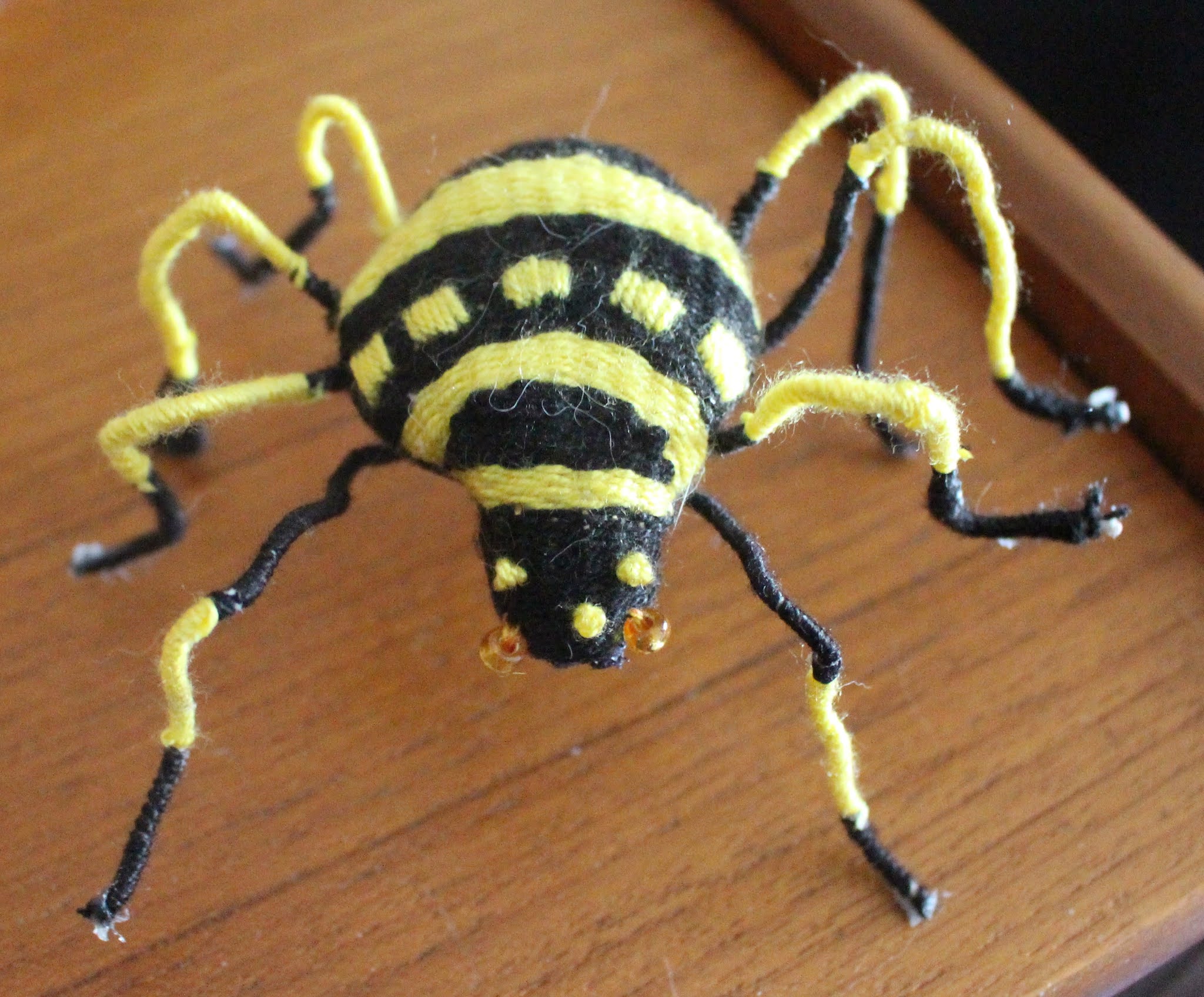
weaving of spider's body


completed spider with wrapped wire legs

weaving of lower half with wrapped vines

weaving of the geometrical patterns


left half of completed weaving

Completed weaving with spider and web.

close up of spider weaving web.


Friday, 28 May 2021

Ikebana Flower Arrangement

 It was suggested to me that I did a picture with flowers. I was feeling a bit tired so decided to embroider a minimalist picture of a Japanese Ikebana arrangement. Although they appear simple to look at, it appears to be about balance.

I made a quick sketch about where I would place things and worked out the number of pieces I would need to make.

I made the flowers first by using an oval wire shape and then pulling  silk chiffon snugly over the top and securing with thread. When the petals were made I painted pink at the base and covered the stems in green silk.


The stamens and stigma were made by rolling narrow pieces of silk in the fingers with a little glue. The container was made with hessian and raffia over the top. This was filled with curly wool to look like moss.


Leaves were cut out and wire attached for the vein and the stems.
Several pieces of wool were zig zagged on the machine to make the branch.

All the pieces were  put together in an Ikebana type arrangement with some embroidered Japanese writing.


Sunday, 2 May 2021

Loving Earth Project 2

 I decided to make another panel for the Loving Earth Project. I love walking down an English country lane whatever the season. There is always something of interest to see and the seasonal change itself is always full of surprises.

According to which part of the country you are in the lanes are different. The edges can be made of hedges, ditches, drystone walls, Cornish hedges, verges. All of these places are home to plants, fungi and animals and need to be looked after if they are to survive for the next generations to enjoy.


Please look after your country lanes so others can enjoy them.

Thursday, 29 April 2021

Plastic Entrapment

 The other week I took part in a zoom meeting held by Nikki Parmenter on plastic entrapment.

Before the meeting I had chosen to make a flying fish and I was posted a small pack of glittery pieces, clear plastic and a pattern.

I drew the pattern on to the plastic and then covered one piece in shiny bits and pieces.


Choosing orange and blue as my colours I free machined over the fish body until mostly covered. I had separated the flying fins so I could stitch those separately.

The eye was then added.


When the stitching was finished another piece of plastic was attached to the back of the body and then stuffed.


The flying fins and sequins were attached.

The fish was then trimmed and neatened,


The fish was finished but I decided to make a background of waves with a splash for the skimming flying fish.


Friday, 9 April 2021

Celandines

 Celandines are one of the first flowers of Spring and they love the sun. As the sun comes out they fully open their petals which reflect the light from their shiny petals.


The dark green heart-shaped leaves set off the yellow flowers. I leave some in my garden but you do have to be careful as they can turn into a garden thug!


I painted some of the celandines from my garden in my sketchbook. At the top of the page you can see some chicken scratch embroidery which reminds me of a celandine.


There are lots of wild flowers to enjoy at the moment!

Wednesday, 24 March 2021

Loving Earth Project

 The Loving Earth project encourages us all to think about the environment and to do one small thing which will help improve the state of the planet. If lots of people do one small thing  this will add up to produce a greater impact.

We were asked to make a panel to represent what we were going to do, or to represent something we have lost and will be greatly missed by subsequent generations.


My Loving Earth panel was about clothes and particularly fast fashion and its effect on the planet and what small thing I could do to help.

Having looked at my wardrobes I decided I had too many clothes. I made a pledge to only buy new basics and wear older items more times and modify other items to update them.

By buying fewer items and extending the life of others hopefully I would be reducing the use of pesticides, cutting water consumption and reducing carbon dioxide in transportation and production.


Close up of a basic skirt and jacket.

The panels will be displayed in exhibitions, all around the country, to heighten awareness that we are all capable of making small changes in our lives to benefit the planet.

Thursday, 18 March 2021

Chicken Scratch Embroidery

 I was introduced to Chicken Scratch Embroidery and I have to admit I had never heard of it let alone tried it.

It is worked on gingham and uses quite simple stitches building up patterns.


Pattern on gingham

Close-up of stitches


After I had embroidered the square I thought what am I going to do with it!
I realised I needed a pincushion so set about making a back by joining scraps and cutting to size. I joined the back and front together leaving a gap. I made a small stuffed square cushion to go inside and then closed the gap. A completed pin cushion!

Front of pincushion


Back of pincushion made with scraps


Here is the pin cushion in use!

Stott Park Bobbin Mill

 The bobbin mill opened in 1835 making a range of bobbins for the Lancashire cotton mills,  mills across the country and across the Empire. ...