Monday, 11 February 2019

Wild Weather


Friday night was a very rough night with wild winds and heavy rain named Erik by the Irish met office. I woke up to no electricity which didn't surprise me as the wind had sounded like an express train and all sorts of things were banging and slamming. As Saturday improved I thought it would be worth taking a look at the river taking my camera with me.
The river was in full spate and it was making a cacophonous roar as it hit the rocks and was funnelled under the bridge.
After the river had passed under the bridge it opened out into the mill pond where there were beautiful surface patterns on the water.

The power of the water was tremendous and further upstream it made curtains as it rushed over the weir.
It was a good walk along the river and the noise of the rushing river was intoxicating.

Wednesday, 30 January 2019

Yellow Leaf

My latest weaving is a yellow leaf in an off- white woven surround. I wanted to practise weaving with a coloured warp so I chose yellow. You can see the warp threads below cut to make a fringe.


 I decided it should be something fairly simple so that I could make  a picture by also using the warp to weave as a weft, thus building up a solid shape.
Because the warp was yellow, when the thread was used as the weft the leaf came out a deep yellow.

The surround of the leaf was woven with three lengths of a knobbly yarn to produce a textured background in contrast to the plain leaf.

Illuminated Letters

Illuminated letters are very beautiful and we also admire the skill of the craftsmen who produced them. It is also possible to make them in stitch.


Page from the Illuminated C14  Lutrell Psalter

I am starting to prepare for a workshop on Illuminated letters in April. I have some samples but I am also working a few more because I have made some new designs.
The letters are printed on tea-stained abaca tissue and then put through the printer to transfer the design.
The tissue is then screwed up and unfolded and then attached to wadding.


It is then painted in rich colours.
The outlines are  machine stitched and the squares and other parts are hand stitched.

Below are a few more samples mounted on print outs of pages from the Luttrell Psalter.


Wednesday, 23 January 2019

Winter January 2019


When we think of winter we tend to think of snow and frost. But most winter days are usually grey and damp rather than white.
Even though many days are colourless, there are plenty of things to see.  One of the most beautiful things is the winter silhouettes of deciduous trees. Without the leaves the texture of the bark and the tangled branches can be seen.


On the dark side of the dry stone walls, the moss grows like green velvet. 

The walls divide up the fields but up close the acid yellow of lichens light up a winter's day.

Lichens come in a variety of colours and can be seen all over the walls. 


If you look closely you can see signs of spring yet to come. Buds tightly folded ready to swell, catkins ready to grow.


There might be snow this coming week so I shall be ready with my camera.
It snowed last night and everywhere looks beautiful.


Tuesday, 18 December 2018

Greek Bronze Age Horse Embroidery


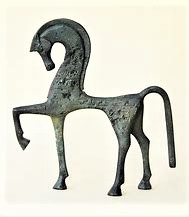
I have always loved the copies of the  Greek Bronze Age horses and a few years ago I bought one for myself as a memento.


The horse was very important to the Ancient Greeks showing wealth,  status, military prowess and adherence to the Gods.
 I just love them because of their shape, colour and pattern.
 I dyed some material in greeny-blue and copper colours and then printed over the top using a natural sponge with metallic bronze and copper.I used these pieces as the background and a piece of shiny fabric representing the tin which when combined with copper creates bronze.
Backgrounds stitched together and the horse appliqued.


I used the patterns on the horses to make patterns down the left hand side and influence the embroidery stitches I used.
Rows of herringbone were added to improve texture

 I made some horse stamps and block printed "ghost horses" with bleach.
 Further patterns were made with copper shim and stitch. Verdigris pieces were sewn into the left hand seam and arrows into the right hand curved seam.

 The background was machine stitched to bring the whole piece together.

Finally when the piece was bound,  the corners were decorated with stitch and beads.


Stott Park Bobbin Mill

 The bobbin mill opened in 1835 making a range of bobbins for the Lancashire cotton mills,  mills across the country and across the Empire. ...